Free Printable New Year Charades Cards
Jump to downloadAct out 24 original New Year party scenes with colorful printable cards, fair team rules, an early-countdown format, and seated alternatives.
A New Year game with scenes people can recognize
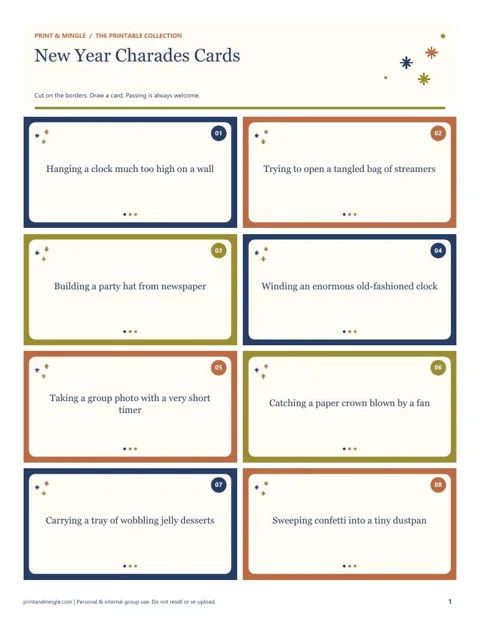
These New Year charades cards turn countdown preparations, party mishaps, and the morning afterward into silent scenes for the group to guess. The twenty-four prompts are original actions rather than celebrity names, film references, or questions about the past year's news. Players can mime hanging an awkward clock, untangling streamers, or sweeping confetti into a tiny dustpan. That makes the deck usable in future years without updating a trivia answer sheet. Use it before a countdown, during a family games evening, or at an early celebration that does not run until midnight. A short game lasts around fifteen to twenty-five minutes, depending on how much time you leave between turns.
What is in the printable and what to bring
The color PDF contains three pages with eight numbered cards on each page. A4 and US Letter versions have the same prompts, with navy, copper, and olive-gold accents. One complete deck is enough for two teams. Print and cut the cards, then put them face down in a bowl or an envelope. You also need a timer and optional scrap paper for scores. The card itself is the answer, so there is no separate solution page. No actual balloons, drinks, scissors, or other props are needed to act the scenes. Keeping everything imaginary makes the setup simpler and prevents players from rushing around the room to collect objects during a turn.
Explain silent acting and what counts as a correct guess
The actor can use gestures, expressions, and movement, but cannot speak, mouth the answer, draw letters, or show the card. Give guessers permission to call out ideas as the scene develops. They need to identify the essential action and its distinctive detail rather than reproduce every printed word. For example, sweeping up confetti with a tiny dustpan is correct even if the guess uses the word miniature. A generic guess of cleaning is not specific enough. The host should decide close calls consistently and explain the distinction calmly. Run one unscored practice scene, such as carrying an imaginary heavy suitcase, so newcomers understand the format before either team has points at stake.
Run a balanced twelve-turn game
Split guests into two teams and choose the first willing actor. Give that actor one card and sixty seconds; a correct guess earns one point and ends the turn. Move the card to a used pile whether it was solved or not. Alternate teams until each has taken six turns, rotating actors so one confident person does not perform every scene. If someone wants to exchange an unfamiliar prompt, allow one swap before starting their timer. Passing after the timer begins ends the attempt without a point. Announce those rules at the start. Accept a tied total, or play one additional turn per team at a time. Both teams should always have the same number of opportunities to score. Keep the unused deck away from the scorekeeper if that person is also guessing, so reading future prompts does not provide an unintended advantage.
Fit the activity around an actual countdown
Choose the game start time by working backward from the moment you want everyone ready for the countdown. Twelve one-minute attempts need more than twelve minutes once you include reading, changing actors, and checking guesses, so leave a comfortable buffer. Stop the game at least a few minutes before the scheduled countdown even if unused cards remain. If time is tight, announce four turns per team instead of six before play begins. For an early children's celebration, use a clearly announced pretend midnight rather than pretending the clock really shows twelve. A New Year's Day gathering can ignore the countdown entirely and use the deck as an ordinary party game after lunch.
Make the performance space comfortable for everyone
Clear a small area where guests can see the actor's hands and face, keeping drinks, cables, and fragile decorations away from feet. Most scenes can be communicated from a chair using upper-body gestures, and a player can skip anything that is uncomfortable to mime. Guests who prefer watching can guess, run the timer, or keep scores. For a cooperative version, let the whole room guess and remove the competition. A remote participant can perform within the camera frame; check that the camera is stable before the timer starts. Do not turn a quieter person's reluctance into a challenge to be overcome. The game needs willing actors, not a compulsory appearance from every guest.
Print, reuse, and change the pace afterward
Select A4 or US Letter to match your paper, use portrait orientation, and print at actual size. Inspect a test page for complete borders before producing the other two sheets. Plain paper works, while printer-compatible cardstock is useful for repeated gatherings. Cut the cards before guests arrive and store the dry deck in a labeled envelope afterward. Record used numbers if you want a fresh selection at the next event. For a less active countdown game, try our New Year would-you-rather cards. If guests want a quieter end to the evening, our reflection cards allow optional conversation or private writing instead of another performance round.
Download The Printable
Free 3-page PDF. Choose your paper size.
US Letter PDF A4 PDFPersonal gatherings and internal group use. Please do not resell or re-upload the files. Usage terms
Original AI-assisted material, checked digitally. No in-person playtest or physical print test; timing is suggested.