Free Printable New Year Reflection Cards
Jump to download24 gentle New Year reflection cards with practical prompts about the past year and small intentions for the next, in a colorful PDF.
Reflect on a year without demanding a perfect highlight reel
These New Year reflection cards are designed for a small gathering that wants a thoughtful pause between louder celebrations. The 24 prompts ask about ordinary routines, useful discoveries, and manageable intentions rather than demanding a list of major achievements. People can answer from a difficult year as well as an enjoyable one. There is no requirement to make a resolution, reveal a personal struggle, or explain a plan they are not ready to share. Allow twenty to thirty minutes for a relaxed discussion with two to ten people. You can also use the cards privately with a notebook, choosing only the questions that feel useful.
Included cards and how the two halves work
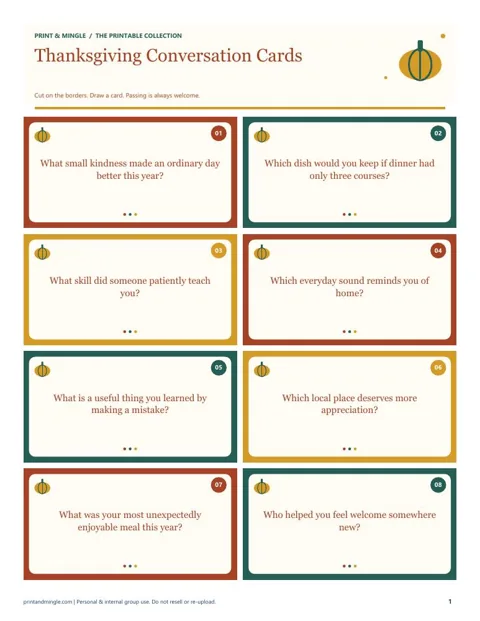
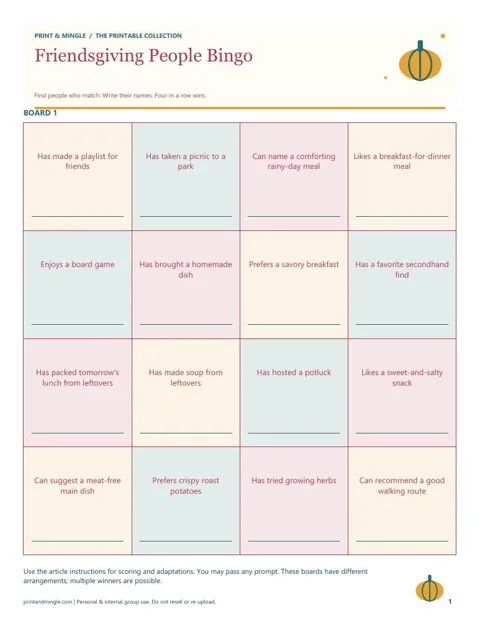
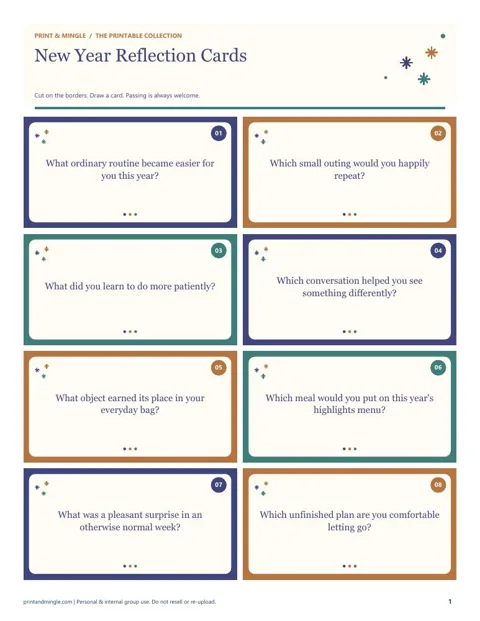
The printable contains 24 numbered cards across three pages, eight cards per page, in an indigo, copper, and muted teal design. Cards one through twelve look back at the past year; cards thirteen through twenty-four look toward the next. Both A4 and US Letter versions contain the same prompts. There is no dated year printed into the questions, so the pack can be reused at a later New Year without outdated trivia. Print one set for shared discussion, not one set per person. Optional paper and pens let people make private notes, but the download itself is a card pack rather than a writing workbook.
Set up a comfortable reflection round
Print and cut the cards before guests arrive, then separate the first twelve from the final twelve. Put each half in its own small pile so you can balance looking back with looking forward. Choose a moment when people can actually hear one another; a room full of countdown music is not ideal for this activity. Tell everyone that passing is unlimited and that a question may be answered privately instead. Ask listeners to avoid immediately giving advice, comparing achievements, or setting goals for the speaker. A host can model a short answer about a practical routine, which signals that ordinary observations are welcome.
How to play, with a specific example
Invite each person to choose one card from the looking-back pile and take a quiet minute to think. Volunteers then read their question and give an answer of roughly one or two minutes. For example, the card about a small decision saving time might lead to a story about keeping a spare shopping bag by the door. A useful follow-up asks what made the change easy to remember, rather than suggesting ten more habits the person should adopt. After everyone who wants to speak has had a chance, repeat with a looking-forward card. Keep the pace flexible and allow a complete round to finish before introducing another question.
Turn an intention into a small experiment
The future-facing cards are invitations, not promises made to the group. If someone wants a practical next step, ask what a one-week experiment could look like and how they would know whether it helped. An answer about making space for reading might become trying ten minutes after lunch on two days, rather than announcing a whole-year target. The speaker chooses whether to share that detail. Nobody needs to check in later unless they explicitly want support. Avoid treating a skipped plan as a failure: deciding that an old idea no longer fits can be a useful outcome of reflection in its own right.
Adapt for pairs, private writing, or a larger gathering
For two people, lay out four cards and each select one for the other person to answer only if they are willing. For private writing, choose one past question and one future question, write for five minutes, and stop without trying to complete the whole pack. With more than ten guests, use pairs or groups of three so each person has room to speak. A shared highlight at the end should be offered by its owner, rather than repeated by a partner without permission. If someone is joining remotely, read the prompts aloud and allow them the same thinking time as people at the table.
Printing, privacy, and a useful closing moment
Use the paper-size version that matches your printer and print a test page at 100 percent scale before cutting. Plain paper works; compatible light cardstock makes the pack easier to store for another year. Keep personal notes with their writers rather than collecting them into a public record. Finish by inviting one optional word describing what each person wants more of next year, or simply thank everyone for listening. Store the cards separately from any written answers. If you return to a prompt the following December, let people decide whether they want to compare with an earlier answer; reflection is not a contract that needs to be audited.
Download The Printable
Free 3-page PDF. Choose your paper size.
US Letter PDF A4 PDFPersonal gatherings and internal group use. Please do not resell or re-upload the files. Usage terms
Original AI-assisted material, checked digitally. No in-person playtest or physical print test; timing is suggested.