Free Printable Book Club Discussion Cards
Jump to downloadSixteen reusable discussion prompts that work across novels, without needing a guide for one particular title.
A reusable fiction discussion deck
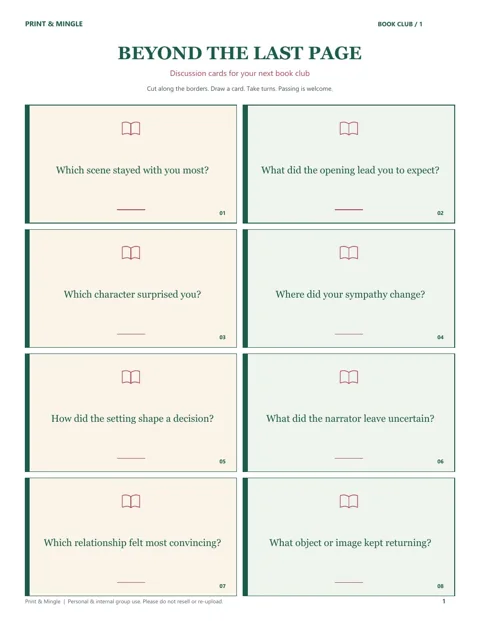
Beyond the last page contains 16 discussion cards across two pages. Each card asks about an aspect of a story rather than a specific published title, making the deck reusable for different novels. Choose A4 or US Letter according to your paper. The suggested group size is 3–10 readers and the suggested discussion window is 30–60 minutes; these are hosting estimates rather than measured outcomes.
The deck asks about memorable scenes, narration, relationships, setting, pacing and interpretations of the ending. It does not contain a plot summary, a quiz or an official author discussion guide. Some prompts will suit a book better than others. You are free to set aside a question when its assumptions do not fit the novel instead of trying to force an answer.
Prepare readers for spoilers
Tell participants before the meeting that these cards assume readers have finished the book and that discussion may include the ending. If someone has not finished, agree on a clear spoiler boundary before drawing cards, or postpone this deck and have a different conversation. A printed spoiler warning cannot protect someone once another reader begins describing the final chapter.
Print and cut one deck for the table. Ask readers to bring their copy of the book if convenient, but do not make ownership of a particular edition a condition of participation. Page numbers vary between print and digital editions. When referring to a passage, give a character, scene or chapter location as well as a page number so others can follow.
Begin with a scene everyone can choose
Start with “Which scene stayed with you most?” Give everyone a brief quiet moment to choose. Invite each reader to mention a scene and one reason it mattered to them; passing remains welcome. This opening allows different points of entry without requiring a single agreed interpretation. Avoid correcting a personal response merely because another reader considered a different scene more important.
Then draw a card and read it aloud. Let a volunteer answer before opening discussion to others. Ask what in the text led them to that interpretation. If the discussion becomes a search for an exact quote, allow someone to describe the scene from memory and check the detail later. The goal is to explore readings of the book, not reward the fastest person to locate a page.
An example of a productive exchange
Suppose the card asks “How did the setting shape a decision?” One reader may argue that distance between characters made a misunderstanding harder to resolve. Another might think the same decision reflects pride rather than location. The facilitator can ask each person which moment supports their view, then explore whether both influences could be present. No fictional example needs to be treated as an answer key for the actual novel.
When two readings disagree, distinguish factual details from interpretation. Checking whether a letter arrived before a journey is different from deciding why a character ignored it. Resolve a factual uncertainty with the text when possible, but allow different supported interpretations to remain unresolved. You do not need to vote on which reader understood the book correctly.
Make room for different voices and books
For a quiet group, let readers choose a card in pairs before returning to the whole table. For a talkative group, invite someone who has not yet spoken before taking another response from a frequent contributor. Avoid calling unexpectedly on a person who has already passed. Allow a few seconds of silence after reading; immediate follow-up questions can crowd out people still forming an answer.
These prompts are primarily designed for fiction. A memoir group may find questions about scenes, setting and recurring images useful, while narrator and character questions may need care. For nonfiction organized around an argument, a purpose-built guide may work better. Do not imply that every card applies equally to every kind of book or that readers need literary training to contribute.
Plan a satisfying finish and preserve the deck
Choose a few cards rather than promising to finish all sixteen. For a shorter meeting, use a memorable scene, one question about character or setting, and a final question about what someone would reread. Reserve time for practical decisions about the next meeting. There is no scoring, elimination or requirement to agree on a rating; an optional rating round should stay separate from the discussion.
Print in portrait orientation at actual size, with the matching paper setting and single-sided pages. Test the first sheet before printing the second. Cut along the card borders, keep text away from the cut and store the finished deck in an envelope. Color gives the forest-and-rose design its character, but the activity does not depend on identifying colors. Share the article link with other clubs; do not upload or sell the PDFs.
Download The Printable
Free 2-page PDF. Choose your paper size.
US Letter PDF A4 PDFPersonal gatherings and internal group use. Please do not resell or re-upload the files. Usage terms
Original AI-assisted material, checked digitally. No in-person playtest or physical print test; timing is suggested.