Free Printable Book Club Icebreaker Cards
Jump to download16 illustrated book club icebreaker cards for friendly reading-habit introductions, with a short first-meeting plan and A4 and Letter PDFs.
A first-meeting introduction that needs no finished book
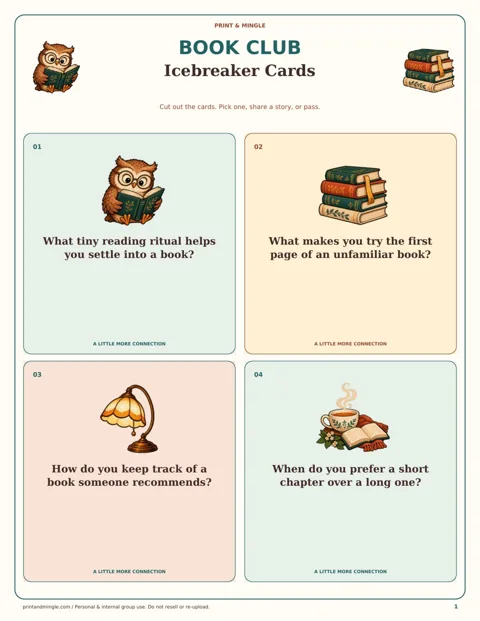
These book club icebreaker cards help readers introduce themselves through small choices and reading habits. Nobody needs to have completed the same novel, remember an author on demand, or defend a reading target. The 16 prompts cover choosing a book, finding a comfortable reading setup, trying different formats, and welcoming new members. Use them for the opening ten minutes of a new club, a meeting with visitors, or a gathering where everyone brings a different book. They are introduction cards, not questions about characters, plot, or the ending of an assigned title.
What the four-page printable includes
The A4 and US Letter downloads each contain the same 16 numbered cards, arranged four per page with colorful book illustrations. Choose the size that matches your paper and print one set for a group of up to 16. There are no correct answers or scores. The numbers make it easy to choose a particular prompt for a future meeting. A single sheet also works for a smaller group: you do not need to print all four pages for a five-minute welcome. Leave enough table space for members to see the cards before selecting one.
Prepare a welcoming opening
Print at actual size and check the first sheet before printing the remainder. Cut along the card boundaries; ordinary paper is sufficient for a single meeting, while compatible cardstock is easier to reuse. Spread the cards face up so guests can choose rather than receiving an unexpected question. Introduce yourself first and explain that a short answer, a different card, or a pass are all welcome. Invite everyone to use the name they would like the group to remember. Keep drinks away from the cards and let late arrivals join without restarting the whole introduction.
A practical ten-minute meeting plan
Allow the first two minutes for choosing cards and thinking. For six people, use the next six minutes for brief introductions, with roughly a minute each. Reserve the final two minutes for a shared observation and the transition to the main meeting. If someone chooses the question about recommendations, they might say that they photograph a cover and then forget to look at the picture. Another member can offer a simple notebook method, but this should not become a tutorial that crowds out the next introduction. The host can close a turn with a thank-you and an invitation to the next willing speaker.
Keep the focus on curiosity, not reading credentials
A guest may read slowly, listen to audiobooks, enjoy comics, or be returning to books after a long gap. Treat these as normal ways to participate. Do not add a follow-up asking how many books someone finishes or whether they have read a famous classic. The card about a slow beginning can be answered without naming a title: one person might sample a few more pages while another puts the book aside. Neither answer needs correction. If recommendations arise, record titles only with enough detail to find them later, and avoid revealing endings to demonstrate your own knowledge.
Adapt for larger groups and different access needs
For 12 to 16 people, make pairs or groups of three and give each group two cards. Let everyone answer within the small group, then invite a volunteer to share one nonpersonal observation. This keeps the opening short. Read a selected question aloud when needed and allow written responses, pointing to a card, or simply listening. For an online club, place one question in the meeting chat so participants do not have to decipher a card held up to a camera. Share the question in advance when preparation would help. No one has to reveal a disability or explain why they prefer a different response format.
Move from introductions to the right next activity
Finish by naming the next part of the meeting: choosing a title, arranging a meeting date, or discussing the assigned book. If you have all finished the same title, switch to the book club discussion cards, which ask about the reading itself. For a gathering built around exchanging books, use the separate book swap game cards. Keep these icebreakers in a labeled envelope and choose different numbers next time. A returning member can answer the same prompt differently; the purpose is a comfortable opening, not completing a checklist of questions.
Download The Printable
Free 4-page PDF. Choose your paper size.
US Letter PDF A4 PDFPersonal gatherings and internal group use. Please do not resell or re-upload the files. Usage terms