Free Printable Book Swap Game Cards
Jump to download24 original book swap prompt cards with a spoiler-free recommendation round, a fair finishing rule, and free colorful A4 and US Letter PDFs.
A book swap that helps readers choose, rather than compete
This printable book swap game turns a pile of books into short, useful recommendations. Guests draw a card, talk about the book they brought, and then choose a new read through an orderly exchange. The 24 original cards focus on reading mood, pace, setting, and audience fit. Nobody needs to identify an obscure quotation or defend a literary opinion. Unlike a discussion of one shared novel, every guest can bring a different title. The aim is to make a thoughtful match between reader and book, not award the most expensive donation or the loudest sales pitch.
Plan for four to twelve adults and roughly 25 to 40 minutes, depending on group size. These are planning estimates, not measured playtest results. Use the activity for a book club social, a neighborhood shelf swap, or a small office reading group. Guests who have not finished a recent book can still take part by bringing an older favorite. Keep the discussion spoiler-free so that the exchange does not reveal the best surprises before anyone starts reading.
What the free printable contains
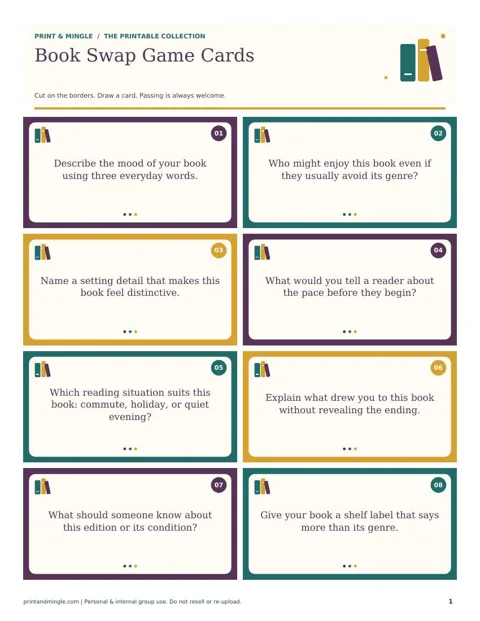
Both downloads contain the same 24 numbered cards across three pages. The A4 file fits A4 paper and the US Letter file fits Letter paper. The original design uses a plum, teal, and golden yellow palette with small vector book illustrations. One set serves a single circle; there is no reason to print 24 cards for every person. The cards are conversation starters for the exchange, not ownership tickets or a trivia quiz. There is no answer key because responses depend on the book each guest has brought.
For the complete activity, gather the card set, scissors, one transferable book per participating guest, blank slips, a pen, and a bowl. Write one number on each slip, from one to the number of people exchanging books. Keep the slips separate from the prompt cards. If a person is joining only to chat, do not include them in the numbered selection round unless an extra book is available.
Set the book boundaries before the gathering
Tell guests that bringing a clean, readable book they already own is welcome. Agree on language and broad audience suitability in the invitation. Ask for books the owner is happy to give away permanently; library loans and borrowed copies stay home. A host can keep one spare book for someone who forgets theirs, but buying a spare is optional. Avoid setting a purchase requirement for an informal swap. If a book has annotations or visible wear, describe that clearly before the selection starts.
Place books on a shared table with the covers visible. This version intentionally uses unwrapped books so that guests can check format, print size, and content notes before choosing. Someone sensitive to a theme may quietly decline a title without explaining personal details. Readers should describe the general mood honestly, especially if an apparently gentle cover hides difficult material. Do not turn another person's preference into a debate about what counts as serious reading.
Run the recommendation round
Shuffle the prompt cards and offer each guest two. They choose one that helps describe their donated book and may exchange either card if it does not fit. Give each person up to a minute to answer, say the title and author, and place the book back on the table. For example, the card about an ideal reading situation might lead to a recommendation for short train journeys, while a card about pace might flag that a story takes time to build. An honest limitation can be more helpful than an enthusiastic but vague promise.
Continue once around the circle before allowing follow-up questions. Nobody has to answer every card. With twelve guests, a single recommendation each leaves more time to browse; with four guests, add a second round using different cards. Make passing explicit at the beginning. If you want a quiet version, guests can write one sentence on a loose slip beside their book instead of speaking. Do not write directly inside donated books unless the owner has agreed.
Use a selection rule that always finishes
Each participating guest draws one numbered slip. In ascending order, each person chooses one available book that they did not bring. Remove the chosen book from the shared table immediately. Stop free selection when just two people and two books remain. Before either of those guests chooses, the host checks both possible assignments. Use an assignment that gives neither person their own original book. If both assignments work, the earlier numbered guest can choose. If only one works, the host assigns that pair. Announce this finishing rule before drawing numbers, rather than surprising the last guest.
For example, if Ana and Ben are the last two guests and Ana's donated book is still on the table, give that book to Ben and the other book to Ana. If neither remaining book belongs to Ana or Ben, either assignment works. There is always a valid assignment because the two remaining physical books have different original owners. Keep a removable owner label inside each front cover if the group might forget who brought which copy. For a two-person swap, simply exchange books and skip the draw.
Handle duplicates, mismatches, and larger groups
If two guests bring the same title, treat the physical copies as separate books and say so before selection. A guest can still choose another person's copy if they want a different edition, although choosing an unfamiliar title may be more useful. After everyone has one book, allow a five-minute voluntary trading window. A trade happens only if both readers agree. End with everyone holding one book; there are no repeated steals, frozen titles, or pressure to hand over a preferred copy.
For more than twelve participants, create smaller circles and explain the same rules to each. Guests may browse across tables afterward, but keep the initial book counts balanced within each circle. If someone dislikes every remaining title, they can take their assigned book and offer a consensual trade later. There is no guarantee that every taste will match. A lending-only group should use a separate sign-out list with an agreed return date instead of treating this giveaway activity as a loan record.
Print, prepare, and keep the next meeting useful
Print one test page at actual size in portrait orientation, then check that the outer card borders remain visible. Use single-sided printing and cut along the straight borders. Ordinary paper works; heavier paper is optional. The numbered cards can be reused at another swap, so store them separately from any notes that contain guests' names. Color is part of the design, but the questions remain readable if your printer uses grayscale.
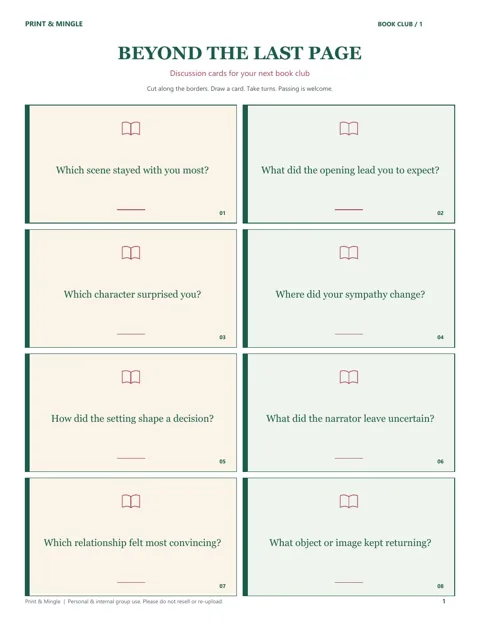
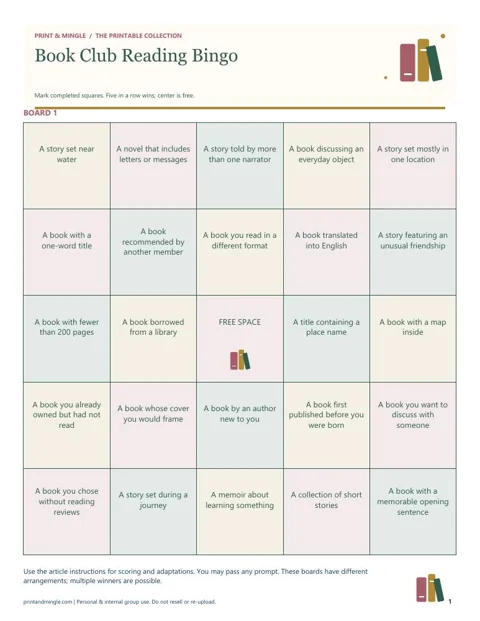
Before leaving, invite each person to name one reason they chose their new book. Keep a voluntary title list if the group wants future recommendations, without collecting contact details as part of the game. For a meeting about one shared novel, try the book club discussion cards. For an ongoing reading goal, the reading bingo pack serves a different purpose. All downloads are available together in the PDF library.
Other book exchange formats
If your group prefers a surprise reveal, Go Beyond Book Club describes a wrapped-book exchange with numbered turns. For a clue-based introduction, Once Upon a Book Club includes a short-description book activity. Choose the format before inviting guests so they know whether to wrap their contribution. The activity on this page uses visible covers, original recommendation prompts, and a final-pair check, so readers can make an informed choice without a stealing round.
Download The Printable
Free 3-page PDF. Choose your paper size.
US Letter PDF A4 PDFPersonal gatherings and internal group use. Please do not resell or re-upload the files. Usage terms
Original AI-assisted material, checked digitally. No in-person playtest or physical print test; timing is suggested.