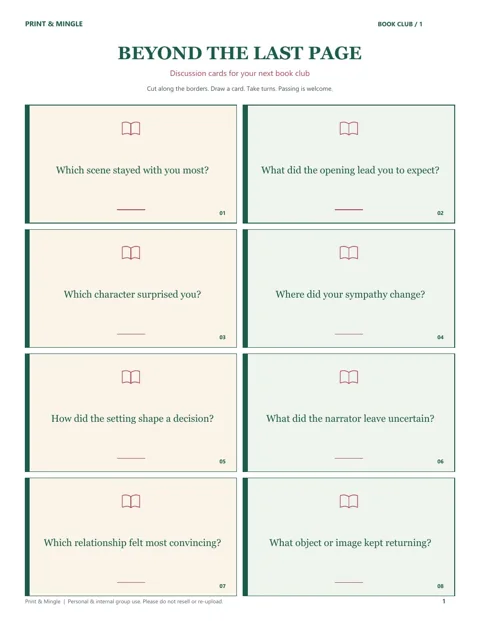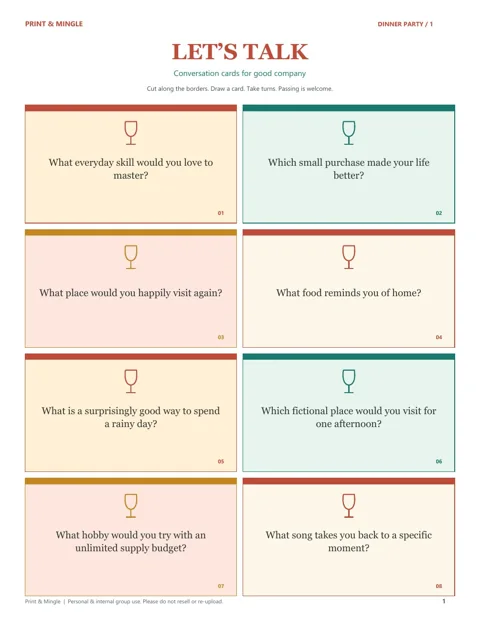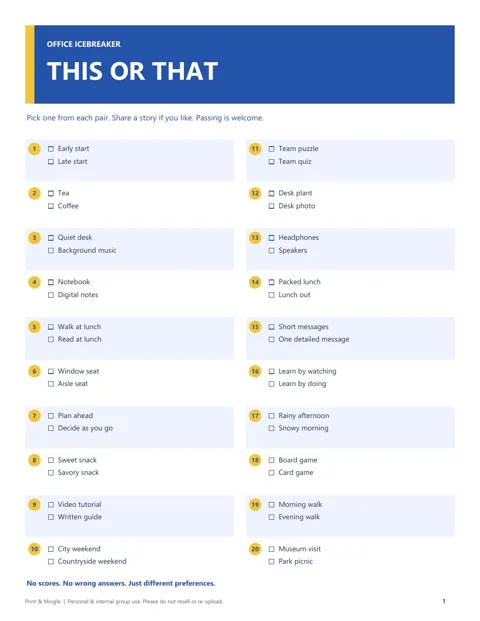
Free Printable Book Club Reading Bingo
Jump to downloadSix colorful reading bingo boards with 24 original prompts for a flexible book-club challenge and a free center.
A reading challenge your book club can shape together
Book club reading bingo turns the next month, season, or year of reading into a set of flexible invitations. Each square suggests a kind of book or a way to choose one, from borrowing a library copy to trying an author you have never read. It is a reading tracker, not a fast party round with a caller. Readers record a completed title in a matching square and work toward a line. Use it alongside your normal book-club choice rather than replacing every meeting with a challenge book. Agree on the length of the challenge before distributing boards so everyone has a fair starting point.
What is on the six printable boards
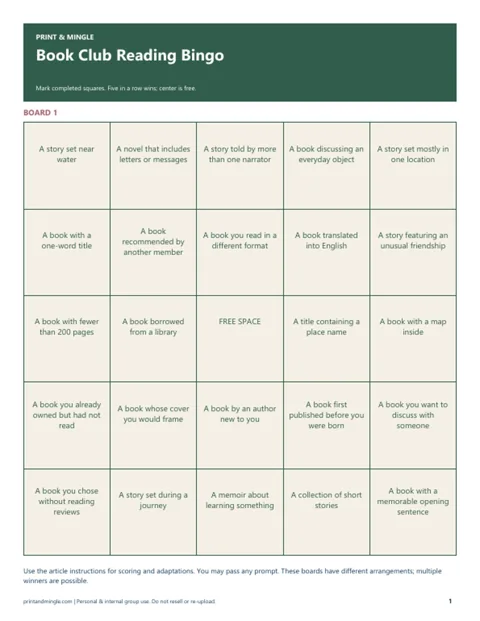
The pack includes six different arrangements of the same 24 original reading prompts on 5 by 5 boards. Each board has a free center, giving 25 spaces in total. The selection of prompts is the same across all six boards; their positions vary, which changes the route to a line. This is not a promise of 144 distinct book categories. Choose A4 or US Letter and print one board per reader. The forest green, rose, and brass palette leaves pale areas for titles and dates. Keep a separate notebook if you want to write longer reviews rather than squeezing them into the squares.
Agree on books, formats, and repeat use
A straightforward starting rule is one completed book per square, with each title used only once on a board. Audiobooks, ebooks, and print books all count equally unless your group has a specific shared reason to choose otherwise. Rereads can count if the group agrees before starting; an already-owned unread book is a different prompt and needs a first read. A single short story does not fill the short-story collection square, but a completed collection does. For memoir and translated-book prompts, use the book's own description or publication information when uncertain rather than guessing from the cover or the author's name.
An example move and how a line wins
Suppose you finish a library ebook by an author new to you, and the story takes place on an island. Several prompts may fit, but under the one-book-one-square rule you choose just one and write the title there. Save other squares for later reads. A row, column, or diagonal of five completed spaces is a bingo; the free center counts automatically. Ask readers to include the title and completion date so they can remember the choice when discussing it. If your group prefers a shared challenge, combine titles on one communal board and celebrate a line when the whole club has contributed.
Keep the challenge manageable
For a one-month experiment, aim for a line rather than a full board, and accept that some readers may complete only one or two squares. A full board requires 24 books under the default rules and is better suited to a longer period. People with different reading speeds should not need to apologize for their totals. Let a reader choose a different square after finishing if the original plan no longer fits, provided they do not count the same book twice. Avoid assigning expensive purchases: library loans, books already on a shelf, and accessible digital editions can satisfy many prompts without a special shopping list.
Use the board to improve the next discussion
At a meeting, invite each interested reader to share one completed square and explain the connection in a minute. The memorable-opening-sentence square can start a discussion about what an opening promises, while the unusual-friendship square can lead to comparisons between characters. There is no need to quote long passages or reveal a plot twist to prove a square. Give a brief spoiler warning when details matter and let members opt out of that part. If several people are stuck on the same category, collect suggestions from books they have actually read rather than inventing recommendations just to fill the board.
Printing, tracking, and ending the challenge
Print a test board at 100 percent scale and check the smallest text and writing space before making a club set. A dark fine-tipped pen is easier to read than a thick marker inside the cells. Put your start date and agreed finish date in the page margin or on a separate note. Photographing your own board can help you remember it while browsing, but ask before sharing another member's name or handwritten notes. At the final meeting, celebrate a favorite discovery rather than just the highest total. Keep the board as a reading record or start a new one with a different time window.
Download The Printable
Free 6-page PDF. Choose your paper size.
US Letter PDF A4 PDFPersonal gatherings and internal group use. Please do not resell or re-upload the files. Usage terms
Original AI-assisted material, checked digitally. No in-person playtest or physical print test; timing is suggested.