Free Printable Winter Indoor Scavenger Hunt
Jump to downloadA 20-prompt winter indoor scavenger hunt with two illustrated field sheets and a host log, designed for calm observation without hiding objects.
An indoor hunt based on observation, not hidden prizes
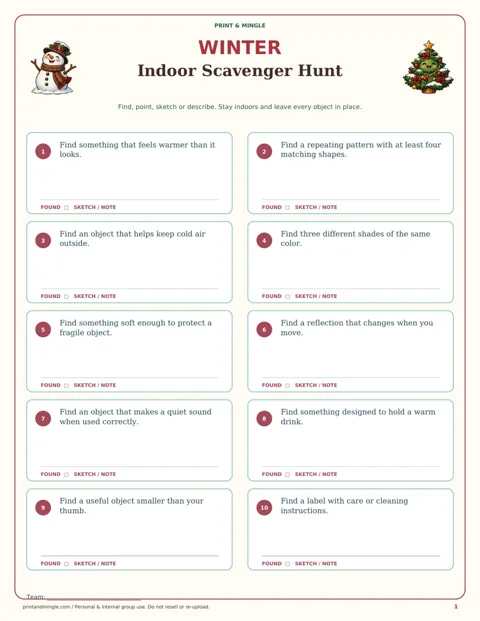
This winter indoor scavenger hunt gives teams 20 open-ended things to find in a home, community room, office social space, or classroom used with permission. Nothing needs to be hidden in advance. Players look for patterns, textures, reflections, useful objects, and safe signs of the season. A valid answer can be pointed out, described, or sketched on the sheet. The prompts deliberately allow more than one solution, so teams can compare how they interpreted the same clue.
The approach is inspired by National Park Service scavenger-hunt activities that invite participants to use their senses, create different kinds of answers, and reflect on what was easy or difficult to find. All wording and the indoor winter format here are original. This pack does not reproduce an NPS hunt or suggest that the agency endorses it.
What is inside the three-page pack
Pages one and two each contain ten numbered field prompts in a two-column layout, with a checkbox and a short sketch or note line. Page three is a route and host log with all 20 numbers, space for brief notes, and a closing question. The design uses compass points, field labels, frosted colors, and map-like route marks. It is distinct from the cut-apart conversation cards and from the archive-journal time capsule pack. A4 and US Letter editions contain identical prompts and numbering.
Print one pack per team, not necessarily one per player. Use actual size or 100 percent scale. Color helps teams distinguish the visual sections, but every instruction also works in grayscale. Clip the pages together or place them on a firm surface if people will carry them. Pencils are useful because they do not need drying time and can be erased when a team changes its interpretation.
Set a clear search boundary before starting
Walk through the area first. Exclude private rooms, storage cupboards, staff-only zones, stairs that become crowded, kitchens in active use, and anywhere containing fragile or hazardous items. Tell players exactly which rooms are included and which doors stay closed. No clue requires opening a drawer, moving furniture, touching an appliance, climbing, going outdoors, or taking an object away from its place. If the location cannot support safe movement, play seated by asking everyone to find answers visible from the room.
The host should say that an object can count without being handled. Pointing, describing, or sketching is enough. Do not photograph people, personal mail, computer screens, security information, medication, or private belongings. In an office, use a meeting room or public common area rather than active workstations. In a home, remove prompts that would draw attention to something a resident prefers not to discuss.
Use a twenty-five-minute team format
Make teams of two to four and give each team a pack and pen. Spend three minutes reviewing boundaries and the no-moving rule. Allow about 15 minutes to work through the prompts in any order, then call everyone back to the starting point. Use the final seven minutes to compare one surprising answer, one difficult clue, and one detail that was initially missed. These are planning estimates, not measured completion times. Stop earlier if the room becomes crowded or the activity has already served its purpose.
For a noncompetitive version, the whole group tries to find one valid answer for every clue. For optional scoring, award one point per explained find and no bonus for speed. Two teams may use the same object if their explanations make sense. Do not require photographic proof. The host can accept a reasonable interpretation, ask a short clarifying question, or mark the clue as skipped.
Examples of valid interpretations
For something that feels warmer than it looks, a player might choose a wool blanket in a cool color or a mug holding a warm drink. The repeating-pattern prompt could be answered by tiles, window blinds, or a row of book spines. A changing reflection might appear in a spoon, dark screen, glass door, or metal decoration as the viewer moves. The quiet-sound clue refers to using an object correctly; a page turning, a keyboard key, or a clock can work without banging anything.
The clue about a safe sign of winter outside might be answered through a closed window: bare branches, condensation, snow, rain, or people wearing coats. Nobody needs to step outdoors. The final prompt asks for a detail not noticed immediately, which makes a good closing observation even if a team does not finish the whole list. Different answers are expected and are the main point of the hunt.
Adapt participation without turning it into a race
A player who prefers to remain seated can be the reader, recorder, timekeeper, or interpretation judge. Bring objects into view only when doing so is ordinary and safe; otherwise describe them. Read each prompt aloud and provide the printed wording. Allow extra time for processing and make passing normal. For remote groups, each person searches only their own immediate room and reports an answer verbally or in chat. Do not ask anyone to show their home on camera.
Younger participants can join with an adult who manages boundaries, while the wording is designed to remain interesting for adults. If walking speed, vision, or hearing varies across the group, remove the time limit and divide clues by role. Competition should never depend on running, reaching high shelves, or touching unfamiliar objects.
Finish by restoring the room
Return to the starting point, account for every team, and collect loose pages. Because the rules do not require moving objects, cleanup should be minimal. If something was moved despite the instruction, return it only when the owner or host confirms the correct place. Invite each team to share one answer that another group interpreted differently. Then end the hunt rather than sending players back for a speed round.
For another observation activity with a seasonal theme, use the Christmas drawing game. For conversation without movement, try the Christmas would-you-rather cards. The indoor hunt works best as a bounded shared exploration, not a reason to search private spaces or collect possessions.
Download The Printable
Free 3-page PDF. Choose your paper size.
US Letter PDF A4 PDFPersonal gatherings and internal group use. Please do not resell or re-upload the files. Usage terms