Free Printable Christmas Drawing Game Cards
Jump to download24 Christmas drawing prompts in colorful printable cards, with clear guessing rules, balanced team scoring, and easy ways to play without artistic skill.
A Christmas drawing game built around small visual scenes
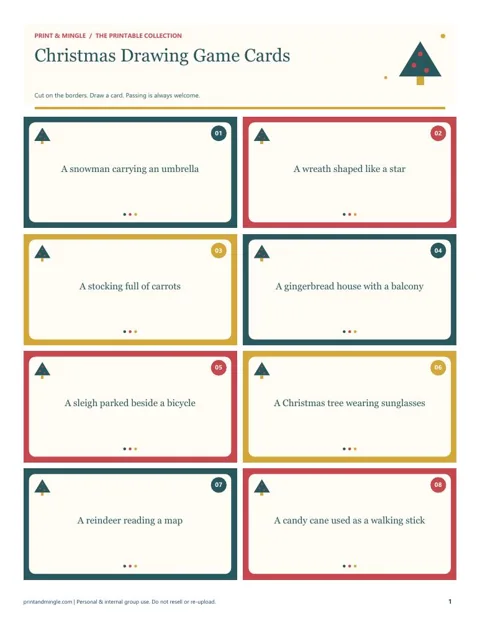
These Christmas drawing cards give a party group 24 original scenes to sketch and guess. Think of the familiar draw-and-guess format often searched for as Christmas Pictionary, using our own printable prompts rather than a commercial board-game set. The cards combine recognizable objects with one unexpected detail, such as a snowman carrying an umbrella or a stocking full of carrots. That gives the artist something concrete to show and gives guessers a small puzzle to solve. Artistic skill is unnecessary: circles, stick figures, and a few connecting lines can communicate the idea. The game suits a family table or a friendly adult gathering where people are happy to draw in front of others.
The three-page deck and the supplies it needs
The download contains twenty-four numbered cards, eight to a page, in deep teal, red, and warm gold. A4 and US Letter versions contain identical prompts. Print one deck for the whole group and cut it into cards. Bring a large pad or a whiteboard, thick pens that are visible from the seats, and a timer. The PDF contains prompts, not a drawing pad, score sheet, or completed illustration for each answer. Keeping the drawings separate makes it easy to display them without showing the secret card. There is no separate answer key because each card names the intended scene. Store the unused cards face down where guessers cannot read ahead.
Set the drawing rules before the first scored turn
Allow pictures, arrows, and simple symbols, but prohibit written words, initials, spoken clues, and acting out the answer. Decide whether numbers are allowed; excluding them entirely is the simplest rule for this particular deck. The artist may point at part of their drawing but should not mouth the answer or confirm individual letters. A guess needs to identify the main object and the unusual detail, not repeat every article and preposition. For a snowman with an umbrella, both parts matter. Demonstrate with an unrelated practice prompt, such as a cat in a flowerpot, before scoring. This lets everyone see that a rough sketch can be enough and gives the host a chance to clarify the rules.
Use equal rounds and a visible timer
Divide players into two teams and choose a willing first artist from each. On a turn, the artist privately reads one card, starts a sixty-second timer, and draws while their own team guesses. A correct scene earns one point and ends the turn. If time runs out, reveal the card and move it to the used pile without awarding a point. Alternate teams and rotate artists. Six turns per team makes a manageable twelve-card game with spare cards left over. Announce that number before starting, and let both sides finish the same number of turns. Keep ties as shared wins or play another complete pair of turns. Do not give only the trailing team extra time midway through. Use a fresh sheet for each turn so an old sketch does not accidentally suggest the answer to the next artist or their teammates.
Help a stuck artist without taking over the drawing
A useful strategy is to draw the largest object first, then add the distinctive detail. For a toy train carrying ornaments, sketch the engine and carriages before putting circles with hooks into one carriage. The artist does not need perspective, realistic wheels, or decoration on every ornament. If a player cannot think how to begin, allow one card exchange before the timer starts. During the timed attempt, a pass can end the turn with no point; agree on that rule for everyone. Avoid offering unsolicited drawing advice while the artist is working. Guessers can call out possibilities, but mocking the quality of a sketch makes the next volunteer much less likely to participate.
Try a cooperative or remote version
For a cooperative game, let one person draw while the whole group guesses, then change artists after every scene. Skip the score and use the timer only as a reminder to offer a new card when the group is stuck. With a remote group, an artist can use a shared digital whiteboard or position paper clearly in front of a camera. Check visibility with the practice drawing before beginning. Participants who prefer not to draw can guess, time, or read cards to the artists privately. For younger players, let two people draw together, but keep both on the same team and explain the arrangement before the round. The activity works best when volunteering is easier than performing perfectly.
Print the cards and finish with a small drawing gallery
Choose the matching paper-size file, print single-sided at actual size, and check that all card borders are present. Plain paper is fine for a single party; compatible cardstock makes the cards easier to reuse. Cut the deck before the event so scissors do not compete for space with snacks. At the end, lay out a few drawings and let their artists explain the ideas if they want to. Ask before taking or sharing photographs of anyone's work. For an activity using movement rather than drawing, try our Christmas charades cards. For a seated puzzle people can complete independently, offer the Christmas word scramble with its separate host key.
Download The Printable
Free 3-page PDF. Choose your paper size.
US Letter PDF A4 PDFPersonal gatherings and internal group use. Please do not resell or re-upload the files. Usage terms
Original AI-assisted material, checked digitally. No in-person playtest or physical print test; timing is suggested.