Free Printable Volunteer Welcome Conversation Cards
Jump to download16 illustrated prompts for a friendly volunteer welcome session, with a practical group plan and optional passes. Free A4 and US Letter PDFs.
A gentle opening before the actual orientation
Starting with a new volunteer group can involve unfamiliar names, rooms, and routines. These 16 cards give a host a way to invite practical questions before a tour or introductory session. They are intended for an optional welcome conversation with adult volunteers, not recruitment interviews, screening, or an assessment of who deserves a role. The questions focus on understanding instructions and finding support. Nobody has to give a personal history or promise a level of commitment in front of the group. Use only a few prompts so the welcome leaves enough time for the information people actually need.
Print one deck and prepare real answers
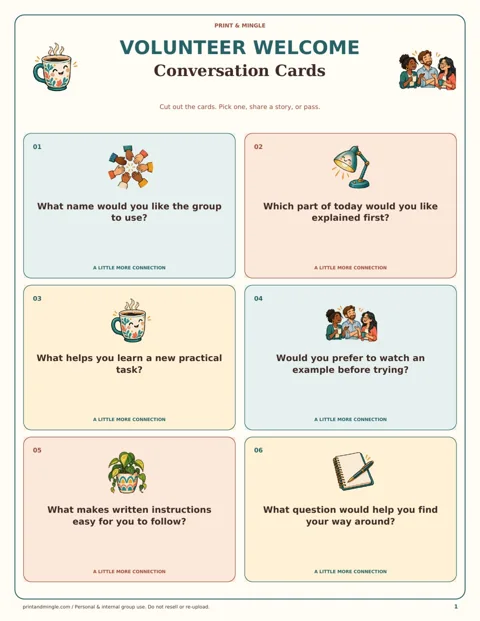
The pack has three illustrated pages with six numbered cards on each of the first two sheets and four on the last, supplied in matching A4 and US Letter editions. Choose the edition that fits your paper and print at 100 percent scale. Cut around the borders or leave the sheets intact for the host to read. Bring a pen and a place to record questions that need follow-up. Before the session, identify the person who can answer practical questions about the space and the role. A friendly card activity will not compensate for missing instructions, an absent contact person, or a confusing arrival arrangement.
Use a fifteen-minute welcome for a small group
For a group of six, introduce yourself and explain the activity in the first two minutes. Give people a moment to look at the cards, then invite each willing participant to choose one question. Allow about a minute for the response and a brief answer from the host when appropriate. Keep the final minutes for summarizing unresolved questions and explaining the next part of the session. These timings are planning estimates. With 12 people, use pairs first and invite a few shared questions rather than requiring a long round. A pass, listening, or choosing another card should always be ordinary options.
Make the response useful rather than evaluative
Suppose someone chooses the question about seeing an example before trying a task. The host can explain when a demonstration will happen and who will supervise the first attempt. That is more useful than labeling the person a visual learner or judging their confidence. Another participant might ask who to contact when instructions conflict. Give an actual role or contact route, then include that information in the welcome notes. If you do not know the answer, record the question, name who will check it, and say when the group can expect an update. Avoid making promises about support that has not been arranged.
Keep private matters out of the group activity
Do not use these cards to invite disclosures about health, finances, immigration history, or the people an organization supports. A preference for written instructions can be accepted without asking someone to explain why. If a private concern arises, offer the organization's appropriate private conversation route instead of discussing details around the table. Read selected questions aloud, make the wording available in writing, and allow extra thinking time. For remote welcomes, place the exact prompt in the meeting chat. Never require someone to reveal an access need publicly as the price of participating comfortably.
Connect the welcome to a complete first day
Finish by naming the next practical step, such as a tour, role briefing, or demonstration. The organization still needs its own orientation, training, supervision, and relevant procedures; this deck replaces none of them. Keep only work-relevant follow-up notes according to normal organizational practices, and avoid treating card answers as a performance record. Reuse the deck when a new cohort arrives, selecting different prompts to suit the setting. For a later optional gathering, human bingo can support mingling. For a working meeting after orientation, meeting check-in cards focus specifically on agendas and decisions.
Download The Printable
Free 3-page PDF. Choose your paper size.
US Letter PDF A4 PDFPersonal gatherings and internal group use. Please do not resell or re-upload the files. Usage terms