Free Printable Office Meeting Check-In Cards
Jump to download18 printable meeting check-in cards focused on agendas, decisions, and useful working habits. Includes a brief facilitation plan and colorful PDFs.
A check-in about the work, with no personal disclosure
These 18 office meeting check-in cards offer a short way to start a practical conversation about the meeting itself. The prompts ask about decisions, definitions, handoffs, and useful notes. They do not ask employees to rate their mood, discuss home life, name a difficult colleague, or reveal a private concern in front of a manager. Use one selected question before a project meeting or team planning session. The cards are a facilitation aid, not an employee assessment, a wellbeing questionnaire, or a substitute for a clear agenda. Skip the activity when the meeting already has a straightforward purpose and limited time.
What is included and what to prepare
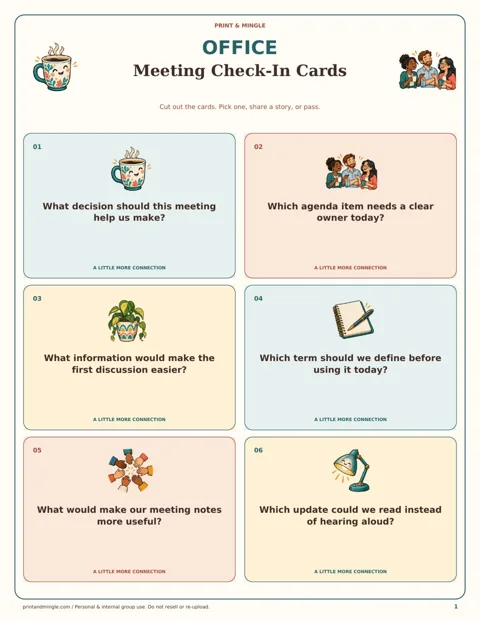
Each download contains 18 numbered cards on three illustrated pages, with six cards per sheet. The A4 and US Letter files contain identical questions. Print the size your printer uses at 100 percent scale and cut along the card boundaries. Bring one set, the actual agenda, and a shared note or board where agreed actions can be recorded. Choose a card before the meeting rather than asking everyone to sort through the entire deck. For a decision meeting, start with the question about the decision you need to make; for a recurring update, try the prompt about updates that can be read.
Run a five-minute opening
Read the chosen question and give everyone a short pause to think. Invite brief contributions, allowing people to pass without explanation. In a group of six, allow about 30 seconds per person and use the remaining time to summarize one practical adjustment. Do not require every participant to give a different answer. If several people need the same missing information, that repetition is useful. Write down the adjustment and move into the first agenda item. For a group approaching 12, ask for written responses first, then read two or three themes instead of holding a long round of individual speeches.
An example that leads to a concrete change
Suppose the selected card asks which term needs defining. Two participants say that the agenda uses the word launch without specifying whether it means internal approval or public availability. The facilitator writes a one-sentence definition next to the agenda item and asks whether that matches the decision being discussed. That is a useful outcome for a short check-in. There is no need to rank the answers or praise one person as the best contributor. If the term cannot be settled immediately, assign a person to clarify it and state which discussion must wait for that answer.
Prevent the opening from becoming another meeting
Some answers reveal a topic that deserves more time than the opening allows. Put it in a visible follow-up list with an owner rather than launching into a separate debate. Avoid turning a question about handoffs into a public review of who made a mistake. Restate it in terms of a missing instruction, decision, or acceptance condition. If someone raises a confidential matter, stop discussing details in the group and use the organization's appropriate private channel. The card activity should not be used to draw out information that employees would not otherwise choose to share.
Make written and remote participation straightforward
Put the exact question in the agenda or meeting chat so people can read it as well as hear it. Allow a response in writing, and do not treat a quiet participant as disengaged. In a hybrid meeting, read relevant written contributions aloud before drawing a conclusion so people in the room and online can follow the same discussion. Avoid photographing personal notes or recording the opening solely to assess participation. When useful, send the question with the invitation; this gives everyone time to find a relevant example instead of improvising under pressure. A host can read the card for someone who prefers that assistance.
Close the loop and choose when to reuse the cards
At the end, check whether the opening's agreed adjustment happened. If the team wanted clearer action items, confirm that the notes include an owner and a next step rather than promising a vague improvement. Keep only notes relevant to the work, following your normal organizational practices. Use a different card when the meeting purpose changes, rather than forcing a daily ritual. For an optional social gathering, our office this-or-that game offers lighter choices. For mingling among colleagues, see office human bingo. These activities serve different purposes and do not need to be added to the same meeting.
Download The Printable
Free 3-page PDF. Choose your paper size.
US Letter PDF A4 PDFPersonal gatherings and internal group use. Please do not resell or re-upload the files. Usage terms