Free Printable Christmas People Bingo
Jump to downloadSix colorful Christmas people-bingo boards for a holiday mixer, with friendly prompts, a free center, printable PDFs, and clear name-collection rules.
A Christmas mixer that gives people a reason to introduce themselves
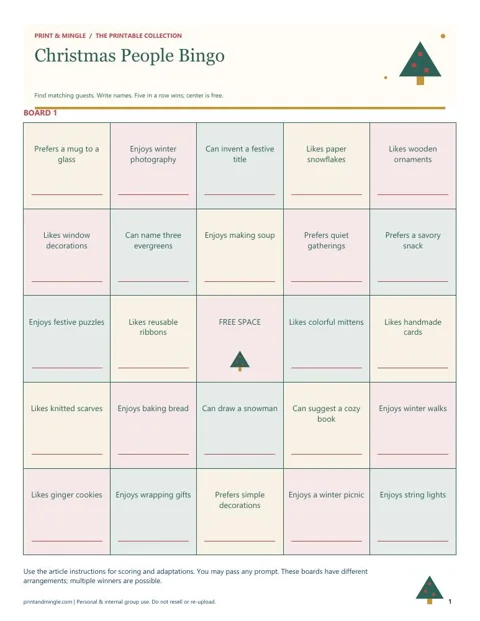
Christmas people bingo is a conversation game rather than a caller reading numbers. Each player looks for guests who match the statements on their board and writes their names in the corresponding squares. The prompts focus on winter preferences, simple creative tasks, and familiar seasonal details, so participants do not need to describe family traditions, spending, or travel plans. Use it near the beginning of a holiday gathering when people are still meeting one another. Six to twenty guests can play, with duplicate boards for larger groups. Allow fifteen to twenty minutes and make participation optional. The point is a few friendly introductions, not a race around the room collecting names without speaking.
The six boards and their limits
Each download contains six different five-by-five boards, one per page, with a free space in the center. Each board uses twenty-four statements selected from a pool of thirty-two, so boards differ in both selection and arrangement. A4 and US Letter versions contain matching board sets. The teal, cranberry, and gold colors distinguish the squares while leaving space for a short first name. This is not a pack of twenty unique boards, and printing more copies repeats the same six layouts. That is fine for a social mixer because people may complete similar boards at different times. There is no caller sheet: the other guests provide the matches through conversation.
Set the name rules before the room starts moving
Give each person a board and a pen, then ask them to mark the free center. A match requires speaking to a willing guest and confirming the statement; do not fill squares based on assumptions about someone. Write that person's first name in the square. For a gathering of ten or more, allow each guest's name at most twice on one board and never let a player use their own name. With six to nine people, allow each name up to four times so the activity remains possible. Explain the rule to everyone before starting. A guest may decline a question without giving a reason, and nobody needs to demonstrate a skill they would rather simply describe.
Choose one clear winning pattern
The standard finish is five squares in a straight horizontal, vertical, or diagonal line, with the free center counting as a filled square. Ask a player who completes a line to tell the host quietly or call bingo, depending on the room. The host checks that each square has a valid name and that the repeated-name limit was followed. Multiple people can complete a line at almost the same time, so accept joint winners. Avoid switching to a full-board requirement without warning; finding twenty-four matches takes much longer than finding one line. If the gathering is primarily social, finish after the announced time and invite everyone to share one enjoyable conversation instead of awarding a prize. Before handing out boards, write the selected repeated-name limit where everyone can see it, avoiding conflicting explanations from different tables.
Turn a match into an actual conversation
Encourage a brief follow-up after a match rather than a rapid request for a signature. If someone likes winter photography, ask what kind of scene they enjoy photographing. A guest who can suggest a cozy book may name one without explaining personal reading habits. Keep follow-ups optional and easy to answer. The playful skill squares, such as inventing a festive title, can be answered with a quick idea rather than a performance. If a square proves hard to match, move to another instead of insisting that someone agree. Hosts should model curiosity and let introductions take longer than a few seconds; a partially completed board can still represent several worthwhile new conversations.
Adapt for seated guests and smaller spaces
A mingling game does not have to require standing or walking. In a small room, form seated circles and let guests take turns reading one of their unfilled squares. Anyone who matches can volunteer their name. Rotate a few willing people between tables if the venue allows it, keeping accessible routes clear. For remote play, read statements aloud and let people respond in chat while players write names on their own copies. Duplicate boards are acceptable in both versions, but do not describe them as unique. If the group has fewer than six people, use the boards as conversation menus instead of a competitive bingo game; otherwise the repeated-name rules dominate the activity.
Print the right number and end with useful introductions
Choose the file matching your paper size and print at actual size in portrait orientation. There is no cutting required because each page is a complete board. Print all six pages once, then selected pages again if you need additional copies. Check that the square text and name lines are readable on a test sheet. Provide ordinary pens and a firm surface to write on; a clipboard is helpful when people are standing. Collect or let guests keep their boards at the end, but do not photograph and publish name-filled sheets without permission. For a seated workplace opener, see our Christmas office icebreaker cards. For a Thanksgiving gathering, our Friendsgiving people bingo uses a different board and occasion.
Download The Printable
Free 6-page PDF. Choose your paper size.
US Letter PDF A4 PDFPersonal gatherings and internal group use. Please do not resell or re-upload the files. Usage terms
Original AI-assisted material, checked digitally. No in-person playtest or physical print test; timing is suggested.