Free Printable Christmas Office Icebreaker Cards
Jump to download24 light office Christmas party questions in colorful printable cards, with a ten-minute meeting format, hybrid tips, and inclusive alternatives.
A short Christmas party opener for colleagues
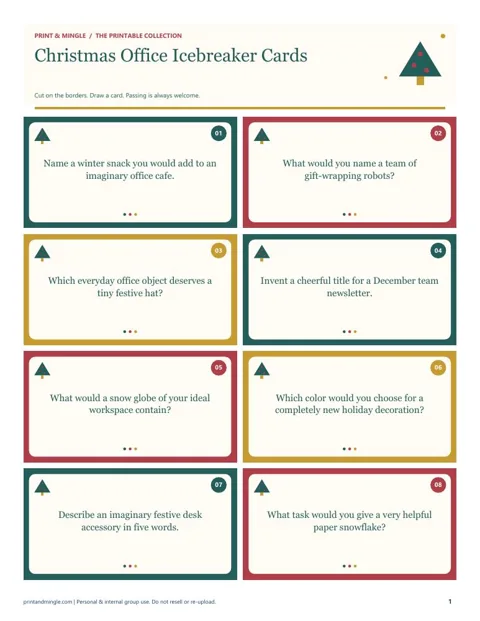
These Christmas office icebreaker cards are written for a workplace gathering where people may know one another mainly through meetings and messages. The 24 prompts invite small creative answers about an imaginary office cafe, festive stationery, winter decorations, and friendly team details. They do not ask colleagues to describe their finances, romantic lives, religious practice, or holiday travel plans. Use them at the beginning of a team lunch or an optional December social, rather than making the activity a surprise assessment. Ten minutes is enough for a few questions. People who do not celebrate Christmas can answer the imaginative prompts or choose a winter-themed alternative without explaining their personal background.
The deck and the preparation you actually need
The PDF has three pages with eight numbered cards per page, in teal, cranberry, and gold. Both A4 and US Letter files contain the same 24 questions. Print one set for a single group and cut it before the meeting; provide extra copies only for separate tables. A host needs a timer if the social has a strict ending, but participants do not need pencils for the basic spoken version. There is no scoring sheet, answer key, or ranking of responses. Review the cards beforehand and remove anything that feels out of place for this particular team. The suggestions below describe optional formats, not additional pages inside the printable.
Use a ten-minute agenda instead of a full-table interrogation
Spend the first minute explaining that participation is optional and short answers are welcome. Choose one imaginative prompt and let neighboring pairs talk for two minutes. Invite three volunteers to share one sentence each, then repeat with a second card. Use the last minute to thank everyone and move to the meal or meeting. This gives a group of twenty a realistic way to participate without waiting through twenty individual speeches. A host can demonstrate a modest answer, such as naming a team newsletter The December Desk, to show that an elaborate joke is unnecessary. Avoid calling on people who have not volunteered merely because they have been quiet.
Run a table version for a longer social
For a relaxed lunch, place three cards face up at each table and invite guests to choose the one they prefer. Give them several minutes to discuss, then replace the cards only when the conversation slows. Different tables do not need to complete the same prompts or report back to the whole room. A person can be a reader, an answerer, or a listener. If a question produces an actual useful suggestion, such as a quieter alternative to a loud game, note the idea only with the speaker's agreement. Do not turn a casual party answer into an assigned work task. The purpose is to make the gathering easier to enter, not to create more obligations.
Make the hybrid version equally easy to join
Read the chosen question aloud and also paste its exact wording into the meeting chat, so remote participants do not have to decipher a card held far from a camera. Let everyone think for fifteen seconds before inviting responses. Use the same short speaking limit for people in the room and on the call. A chat response counts as participation; cameras do not have to be switched on for this game. If the in-person table is discussing in pairs, give remote guests their own small breakout group or use an all-group question instead. Avoid leaving remote colleagues watching a room they cannot hear while the host assumes they are included. For an event with new starters, give a practical introduction before the game: where refreshments are, when the gathering ends, and whom to ask about the room. An icebreaker cannot replace that basic welcome. Clear logistics help people relax enough to choose whether they want to join the conversation at all.
Keep the tone comfortable across roles and traditions
Tell managers and team leads to model concise answers and avoid judging which response is funniest or most creative. An employee may reasonably prefer not to perform in front of someone who evaluates their work. Passing should be ordinary and unremarked upon. Choose the winter postcard, welcome-sign, or quiet-game prompts when you want the least Christmas-specific round. Do not ask someone who celebrates differently to explain their tradition on the spot. Equally, avoid teasing a person for enjoying festive decorations. The deck provides a shared fictional setting; participants can answer within that setting without disclosing what their home looks like or how they spend a holiday.
Print well, close clearly, and choose the next activity
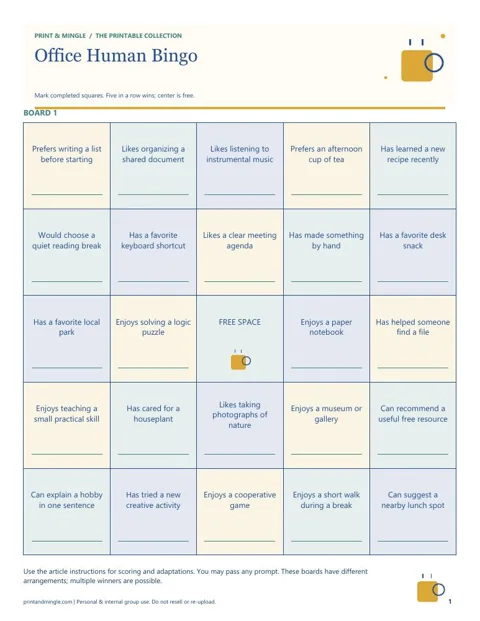
Print at 100 percent on the matching paper size and check one page for complete borders before printing the rest. Standard paper is sufficient for a single event, while compatible cardstock makes a deck that can be reused. Keep the cards near the reader rather than placing them under wet cups or food. End at the promised time and give a clear transition to the next part of the event. For a gathering that needs more movement and voluntary introductions, try our office human bingo. For an ordinary dinner with friends rather than a workplace event, the Christmas conversation cards offer a different table setting and broader personal storytelling.
Download The Printable
Free 3-page PDF. Choose your paper size.
US Letter PDF A4 PDFPersonal gatherings and internal group use. Please do not resell or re-upload the files. Usage terms
Original AI-assisted material, checked digitally. No in-person playtest or physical print test; timing is suggested.