Free Printable Winter Wildlife Tracks Bingo
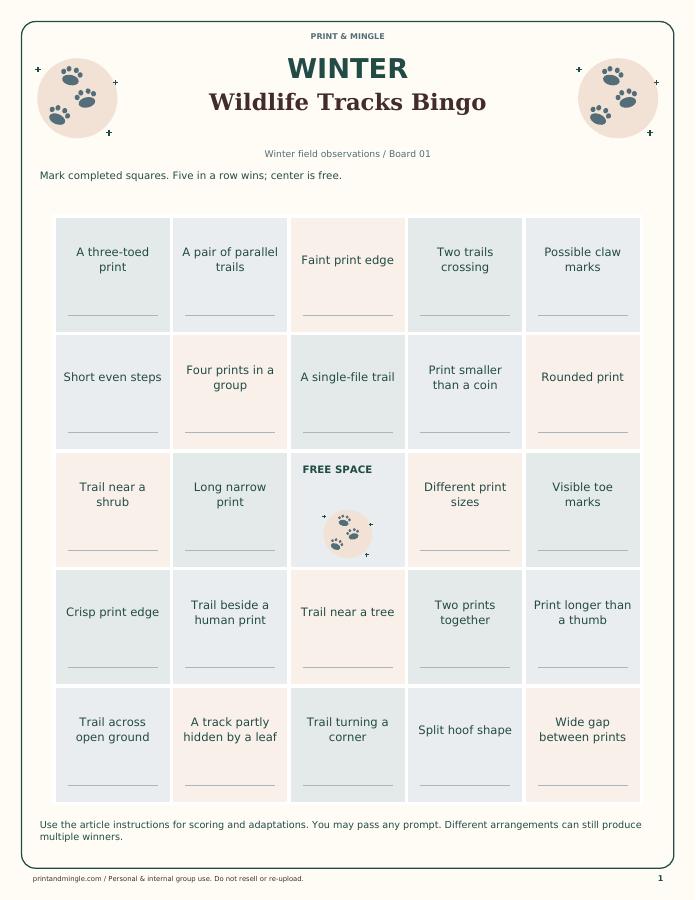
Jump to downloadUse six printable observation boards to compare tracks, trail patterns and winter wildlife clues.
Set up an observation round
Give each team a different board and agree what counts before play. A mark needs a specific piece of evidence, such as a sketch of a split print or a description of four prints in a group. A guess about the animal can be discussed after the observation is recorded.
On a short outdoor route, stop where everyone can see the prints from the path. Trace a few successive impressions with your eyes and compare the spacing. Take a photograph with a familiar object nearby for scale if you can do so without disturbing the track.
Play indoors with reference photos
Show a wide photo first so teams can examine the pattern. Then reveal a close-up of one impression from the same trail. Ask what the close-up confirms and what remains uncertain. Pause before moving to the next photo so players can record a square and give their reason.
For a tiebreaker, show the class two trail photos. Give players one minute to name an observable difference, such as the distance between groups or the size of the front and back impressions. Accept several answers when the evidence supports them.
Read the pattern as well as the print
A snowshoe hare can leave larger hind prints ahead of its smaller front prints as it hops. A fox can follow a straighter sequence in which a hind foot lands in a front print. Use these as comparison examples. A partial trail or a print blurred by weather may support more than one explanation.
The National Park Service Patterns in the Snow exhibit illustrates hopping and walking patterns. End the round by asking each team to share one solid observation and one question that would require a clearer photo, another print or a field guide.
Keep a short field record
Leave room next to the board for a date, a location and a few words about the surface. A print in loose powder may look different from a print in the thin crust beside it. Ask players to sketch their clearest example first, then mark a second square only if the evidence for it is also visible. A single photo can support several observations when players can point to each one.
For a cooperative finish, give the group a shared goal of twelve different observations. When a player spots something already recorded, invite them to compare it with the earlier example rather than racing to claim another square. Look for direction changes, an interruption in the trail or a difference in spacing. On days without snow, use a photo round or compare impressions in soft mud from a suitable path.
Download The Printable
Free 6-page PDF. Choose your paper size.
US Letter PDF A4 PDFPersonal gatherings and internal group use. Please do not resell or re-upload the files. Usage terms
Original AI-assisted material, checked digitally. No in-person playtest or physical print test; timing is suggested.