Free Printable Thanksgiving History Word Search
Jump to downloadA source-informed 18-word Thanksgiving history puzzle with a highlighted answer key, careful context, and colorful A4 and US Letter PDFs.
A Thanksgiving word search built around documented history
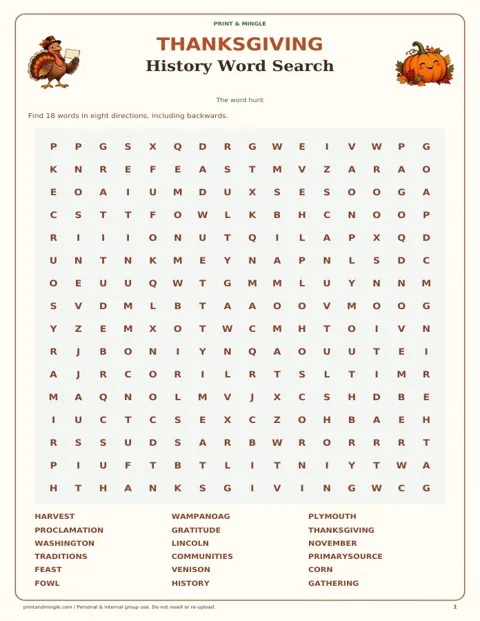
This printable Thanksgiving history word search turns 18 carefully selected terms into a 16-by-16 puzzle. The list includes Wampanoag, Plymouth, proclamation, harvest, communities, primary source, Washington, Lincoln, and other words that help a group talk about how the holiday developed. It is a word puzzle, not a claim that one simple meal explains the entire history. The Library of Congress primary-source set shows that thanksgiving observances took different forms in different places and periods, and that Native communities practiced giving thanks long before European settlement. The article keeps that context visible instead of presenting a tidy origin myth.
Use the sheet for a quiet family activity, a classroom-adjacent gathering, or an adult puzzle table. One person can solve independently, pairs can compare search strategies, or a host can invite a short source discussion after the puzzle. Plan about 15 to 25 minutes. Players may stop at any time, and the historical conversation is optional. The puzzle does not test religious belief, family tradition, or personal gratitude; it simply offers a structured set of terms drawn from public historical material.
What the two-page pack contains
Page one contains the player puzzle and all 18 target words. Words may run horizontally, vertically, or diagonally, forwards or backwards, and each answer stays in a straight line. Page two repeats the exact grid with every answer path highlighted. A4 and US Letter editions contain the same letters, terms, and solution. Print one player page per person or pair and keep a single answer key with the host.
The list deliberately mixes people, places, food, civic records, and interpretive terms. PRIMARY SOURCE appears without a space in the grid, as does any multiword entry. FOWL and VENISON connect to surviving descriptions of the 1621 harvest gathering, while PROCLAMATION, WASHINGTON, LINCOLN, and NOVEMBER point toward later national observances. COMMUNITIES and TRADITIONS remind players that no single account represents every family, nation, or region.
How to solve without guessing at the history
Cross off a word only after tracing every letter in order. Start with a long term such as PROCLAMATION or THANKSGIVING because its letter pattern gives more evidence than a short word like CORN. Find the first letter, inspect all eight possible directions for the second, and continue in one straight direction. Words may overlap and share letters. If a mark becomes crowded, use a second pencil color for the remaining answers.
The answer key verifies locations, not historical interpretation. Finding WAMPANOAG does not mean the sheet has told the full history of the Wampanoag people, and finding FEAST does not prove that every modern tradition came from the 1621 event. When a term raises a question, use the linked Library of Congress set to inspect the referenced proclamations, letters, images, and teaching notes rather than inventing an answer from the puzzle alone.
A careful host conversation after the puzzle
After everyone has had enough search time, invite players to choose one word they would like to investigate. A host might compare the 1789 Washington proclamation with Lincoln's 1863 proclamation, or ask why the phrase primary source matters when later illustrations depict earlier events. Keep answers tentative when the evidence is incomplete. The Library of Congress notes that only a few firsthand accounts describe the 1621 gathering and that later pictures often reflect the era in which they were made.
Avoid asking Native participants to explain history for the group. Do not turn the activity into a debate over anyone's family observance. A useful finish is to name one fact supported by a source and one question that remains open. If children are present, adults can model the difference between evidence, tradition, and inference in plain language without requiring a formal lesson.
Optional scoring and accessible adaptations
For a timed round, allow the same 15 minutes to every solver and award one point per completely traced listed word, up to 18. Shared winners are fine. A host can give a gentle hint by naming a direction or identifying the upper or lower half of the grid. Do not reveal the exact starting square unless the solver asks for a stronger hint. Untimed cooperative play is equally valid and often better for a mixed-age table.
For larger print, zoom the PDF on a screen or use an enlargement setting after checking that no grid edges are cropped. A partner may point while another person circles. Readers who find backwards words difficult can begin with forwards-only hints. Someone may also use the word list as a discussion menu without solving the grid. The same printed puzzle should never be described as a new challenge on a second playthrough.
Print, check, and follow the sources
Choose the PDF matching the paper loaded in the printer, use portrait orientation, and print at actual size. Check one copy for complete borders and readable letters before making a group set. Pencil is useful because overlapping words can make corrections easier. Keep food and drinks away from the answer key until the activity is finished.
The historical source links are part of the article so hosts can verify claims and explore the original material. The Library of Congress Thanksgiving classroom set, its November 26 history page, and its free-to-use Thanksgiving image collection were used to select and contextualize the terms. For a different puzzle style, try the Thanksgiving word scramble; for a movement-based option, use the Thanksgiving indoor scavenger hunt.
Download The Printable
Free 2-page PDF. Choose your paper size.
US Letter PDF A4 PDFPersonal gatherings and internal group use. Please do not resell or re-upload the files. Usage terms