Free Printable Thanksgiving Charades Cards
Jump to download24 original Thanksgiving charades cards for family and Friendsgiving games, with color PDFs, balanced team rules, and seated play options.
Act out Thanksgiving scenes instead of memorizing trivia
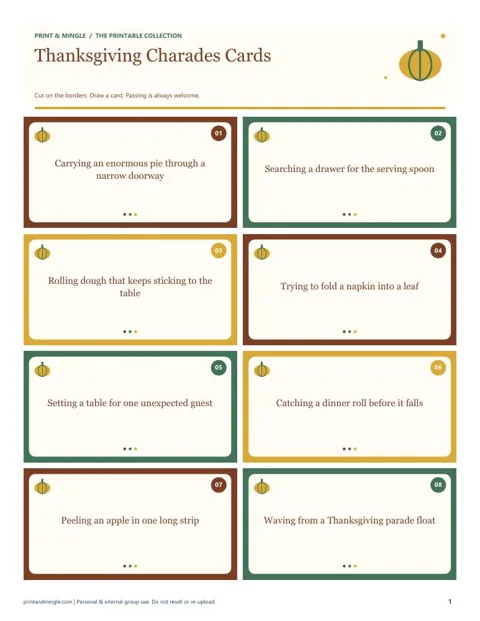
These Thanksgiving charades cards turn everyday scenes around an autumn gathering into short silent performances. There are 24 original action prompts, including carrying a pie through a doorway, chasing a windblown hat, and squeezing leftovers into a small container. The humor comes from the action, rather than impressions of relatives or jokes at someone's expense. Use the deck after dinner, during a Friendsgiving break, or before dessert while the table is being cleared. Four to sixteen people can play in two teams, with a suggested fifteen to twenty-five minutes for a short session. A smaller group can work cooperatively and try to guess each scene together without keeping scores.
What the printable contains
The color download has three pages with eight numbered cards per page. Both paper-size versions contain the same deck. Brown, leafy green, and gold accents suit an autumn table, and the prompts describe actions rather than single abstract ideas. One full deck is enough for the group; there is no separate answer key because the text on each card is the answer. Print and cut the cards before guests sit down, then put them face down in a bowl. You will also need a timer and a scrap of paper if you want to keep score. The pack does not include score sheets or blank cards, so provide those separately if needed.
Set the room and the guessing rules
Choose a clear performance space where seated guests can see the actor's hands. Move hot drinks, fragile decorations, and serving dishes out of reach. Explain that acting is silent: no speaking, mouthing the words, spelling letters in the air, or pointing at the printed card. Imaginary props are encouraged, but actual kitchen equipment is unnecessary. A player can mime opening a drawer or balancing plates while remaining seated. Agree that the important action and object are enough for a correct guess. For example, a guess of carrying a huge pie through a door captures the first card even if it does not repeat every printed word. The host settles close calls consistently.
Run an equal-turn team game
Split players into two reasonably balanced teams and choose a willing actor from the first team. Give that actor one card and sixty seconds to communicate its scene. A correct guess earns one point and ends the turn; an unguessed card earns zero. Alternate teams, rotating actors so the same confident performer does not take every turn. Announce six turns per team for a short twelve-card game. That leaves spare cards and gives both sides equal opportunities. If an actor passes immediately, replace the card before starting the timer; a pass during a timed attempt ends that turn without a penalty beyond the missed point. Use the same rule for everyone.
A sample round and a sensible ending
Suppose the actor draws the prompt about packing leftovers into a tiny container. They can gesture scooping food, notice the container is full, press an imaginary lid, and react when it springs open. A teammate who guesses putting leftovers in a box has identified the scene and earns the point. The actor does not need to demonstrate each adjective. Put the used card in a separate pile even if nobody guessed it, so the next team does not receive an answer everyone just heard. Stop after the announced equal number of turns. Accept a tied score, or give both teams one extra turn per round until the tie breaks; never award only one side an extra chance. Before the first scored turn, run a practice scene that is not in the deck, such as opening a heavy imaginary window. That lets guests agree on how much detail a guess needs. Correct any misunderstanding during practice, when no team has a point to lose, rather than midway through the competition.
Adapt the deck for children, quieter guests, and seated play
Read unfamiliar words privately to a younger actor before the timer starts, then let them choose whether to perform with an adult. For guests who prefer not to act, guessing, timing, and reading cards are equally useful roles. A seated version can use hands, facial expressions, and upper-body gestures; skip any scene a player finds uncomfortable. Avoid asking the group to vote on the best performance, which can turn a low-pressure game into an audition. For a cooperative round, remove the timer and let everyone suggest guesses until the actor wants a new card. With a remote guest, frame the camera so gestures are visible and leave a little extra time for audio delays.
Print, store, and pair with a calmer activity
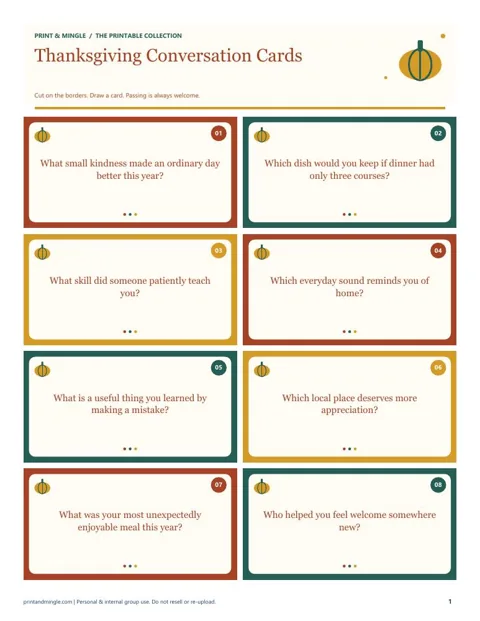
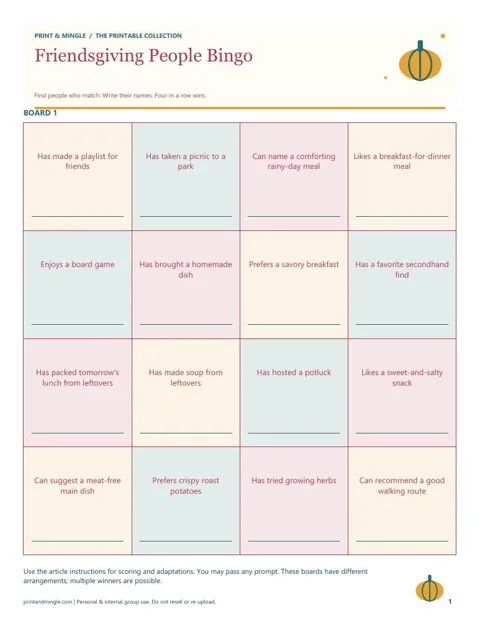
Use A4 or US Letter to match the loaded paper, print at 100 percent scale, and inspect one sheet before printing the remaining pages. Plain paper works for one gathering; printer-compatible cardstock can make a reusable deck. Cut around the card edges and keep the cards dry before storing them in an envelope. Label it with the game name and record the card numbers already played if you want fresh prompts next time. After the active game, our Thanksgiving conversation cards offer a quieter table activity. For guests who want a puzzle instead of performing, set out the Thanksgiving word scramble at a separate table.
Download The Printable
Free 3-page PDF. Choose your paper size.
US Letter PDF A4 PDFPersonal gatherings and internal group use. Please do not resell or re-upload the files. Usage terms
Original AI-assisted material, checked digitally. No in-person playtest or physical print test; timing is suggested.