Free Printable Dinner Party Would You Rather Cards
Jump to download24 original would-you-rather cards for adults at dinner, with low-pressure choices, a prediction game, and a colorful printable.
Two choices, one useful conversation starter
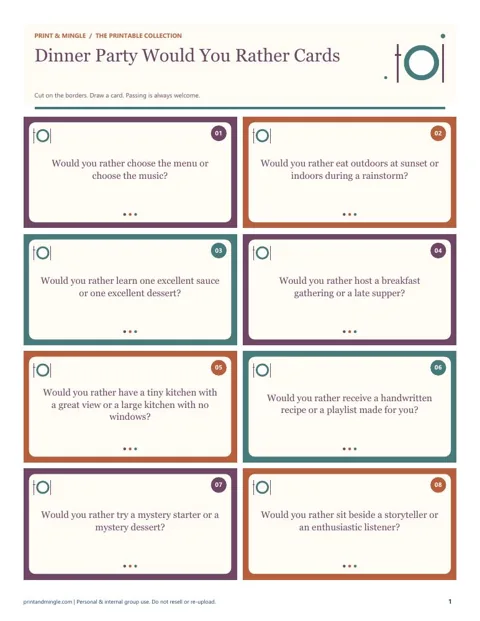
Dinner-party would-you-rather cards give adults a simple choice that is easy to answer before a longer conversation develops. This pack focuses on food, hosting, places to eat, and the atmosphere around a shared table. The 24 questions avoid graphic dares, private relationship details, and demands to reveal embarrassing stories. Guests choose between the two printed options and may explain their preference, but an explanation is never compulsory. Use the cards after a first course, while waiting for dessert, or at a small gathering where a structured game would feel too formal. Fifteen to twenty-five minutes is enough for several questions without taking over the whole meal.
What is in the color PDF
There are 24 numbered cut-apart cards, arranged eight per page across three pages. A4 and US Letter downloads contain the same original choices, with plum, terracotta, and muted turquoise accents. One printed set serves the whole table because a reader can share each question aloud. There is no answer key: preferences are personal, so neither option is automatically correct. The basic conversation version requires only the cards and scissors. If you choose the optional prediction game below, provide a small piece of paper and a pen for each player. The PDF does not include separate score sheets or an unlimited supply of extra questions.
Prepare the pack and explain the rules
Print a test page at actual size, check that the card boundaries are complete, and cut the full set. Remove any question that does not fit the group or the setting before shuffling. Place the cards face down in a bowl or choose six to lay beside the host's place. Explain that each question offers two imaginary choices: players can pick the one they prefer even if neither describes their everyday life. Anyone may pass or ask for a different card. Do not turn a food preference into pressure to taste something, change a dietary choice, spend money, or justify why a particular activity is inaccessible.
Play the conversation version
One person draws a card, reads both options, and makes their choice. Invite two or three other guests to respond before moving to another card, rather than insisting on a full-table vote every time. For the choice between controlling the menu and controlling the music, one guest might prefer the menu because they enjoy planning small plates, while another chooses music because they like setting a relaxed pace. Ask what they would actually choose, rather than arguing about which answer is objectively better. Change readers after each card. With a quiet group, give ten seconds of thinking time before inviting the first answer.
Add a prediction game with clear scoring
For a light competitive version, choose a willing featured guest for each round. That person privately writes A for the first option or B for the second while everyone else predicts their choice on paper. Reveal simultaneously after a short countdown. Each correct prediction earns one point; the featured guest does not score during their own round. Rotate so every player is featured once, giving everyone an equal number of scoring opportunities. A tied total stays tied unless you agreed on another equal round beforehand. This measures guesses about the selected preferences, not friendship quality, and nobody should be teased for choosing differently from what others expected.
Adapt the activity to the people at the table
For a pair, take turns selecting a card and choose whether to answer at the same time or listen to one another first. For a table of twelve, break into neighboring pairs for two questions, then invite a voluntary highlight to the whole group. A remote guest can listen to the host read each prompt; there is no need for everyone to have a separate printed deck. If someone prefers not to speak in a group, they can quietly indicate A or B or simply listen. Keep cards away from open flames, wet glasses, and serving dishes, and pause the activity whenever hot food needs everyone's attention.
Printing, storage, and ending on the right note
Use the download that matches your paper and leave the printer set to 100 percent rather than borderless enlargement. Ordinary white paper is enough for one dinner; compatible light cardstock is useful when you want to keep the deck. Place used cards in a separate pile so the same prompt does not appear repeatedly during one evening. Stop after the number of questions you announced or whenever the conversation continues comfortably on its own. The final card, about repeating the meal or inventing another, can provide a natural closing discussion. Store the dry cards in an envelope and mark favorite numbers separately so the prompts remain readable for the next gathering.
Download The Printable
Free 3-page PDF. Choose your paper size.
US Letter PDF A4 PDFPersonal gatherings and internal group use. Please do not resell or re-upload the files. Usage terms
Original AI-assisted material, checked digitally. No in-person playtest or physical print test; timing is suggested.